90 PAGES · EVERY PRICE FROM 1900–1975, CONVERTED TO TODAY’S DOLLARS
Nobody Ever Wrote It Down. So We Did.
Ask someone who was there what bread cost in 1955 — they’ll tell you to the penny. What Things Cost, 1900–1975 is a 90-page record of those prices and the paychecks that met them, transcribed from the government’s own bulletins and converted — every single figure — to today’s dollars.
- Six decade chapters — from the nickel bread of 1900 to the gas lines of 1975 — then three more that do the arithmetic on all of it
- Every figure cited to bulletin, table, and page — so you can check us, not just trust us
- Large, comfortable type — made to read, made to print, yours forever
7-day money-back guarantee. PDF, 90 pages, works on any device — no apps, no subscription, no nonsense.
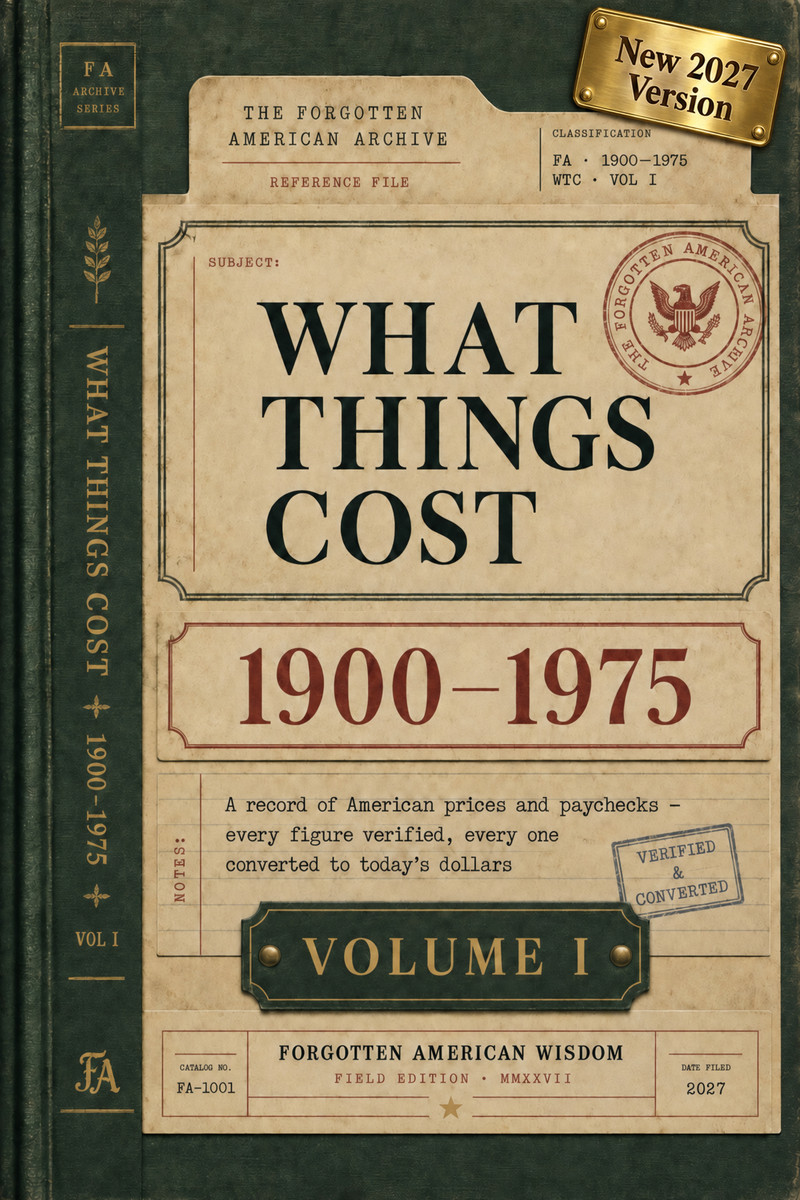
VOLUME I · 90 PAGES · 2027 EDITION
Converted with the Bureau’s own Consumer Price Index — the method is printed in the book.
Three entries from the record. The book holds hundreds — and the further back it goes, the stranger the arithmetic gets.
A Note From the Archive
Every day on our channel, we tell the story of how careful American households actually lived — and every day, the comments fill with the same two sentences: “My mother did exactly that,” and “Can you believe what things cost then?”
This book is the answer to the second one, done properly. Not a nostalgia list — a record. We went back to the government’s own price bulletins, the census tables, the wage series, and wrote down what they say, decade by decade, next to what those numbers mean in today’s money. Where a table needed a human voice, we used the words of people who were there — recorded by the Federal Writers’ Project and the archives that kept them.
One of those voices is Elizabeth E. Miller, of West Newbury, Vermont, who sat down with a Federal Writers’ Project interviewer in 1938 and described her farm years without a trace of nostalgia: “I bought twelve and a half yards of calico and made a dress out of it myself.” She is in Chapter One, beside the 1913 counter she shopped only at the edges of — and she is the one who gave that whole era its epitaph: “Life is nothing but changes.”
We set it in large type on plain letter paper on purpose, because we know what happens to pages like these. They get printed. They end up inside a cupboard door or under a magnet on the refrigerator, where somebody can walk over and check a number in the middle of an argument.
It’s history, not financial advice. It’s made to be read aloud when family visits. And it’s the first volume of the record we’re building — written down, at last.
Forgotten American WisdomTHE ARCHIVE SERIES · EST. MMXXVI
The Whole Ledger, Chapter by Chapter
Six chapters walk the decades — each opens with a voice from the time and lays the prices beside the paychecks. Three more do the arithmetic your grandmother did in her head, and one holds the multipliers so you can do it yourself.
The Nickel Decades
The nickel loaf, the dime that opened a post-office savings account, and the war that ended the stillness — where the record begins.
The 1913 loaf ran 5.6¢ a pound — $1.90 in today’s money — against an average year’s earnings of $633.
The Electric Decade
Radios, washing machines, the Model T at its cheapest — and what “prosperity” cost per week.
The cheapest new Ford there ever was listed at $260 — under eleven weeks of the $24.11 factory week. For that price, you cranked.
The Careful Years
The Depression household ledger: relief budgets, the $3.86 grocery week, and prices that refused to matter less.
W.P.A. relief work paid $47.29 a month in 1936 — about $1,140 today, and less than half a factory wage.
The Ration Book
Points, the Sugar Book, and the bond bought a dime at a time — when the government decided how much sugar a family could buy.
The first housing census, 1940: the median American house, $2,938 — about 118 weeks of the $24.96 factory week.
The $7,990 House
Levittown, the 75¢ minimum wage, and the decade a factory paycheck could buy a home.
A veteran moved in for nothing down and $56 a month — about 39 hours at the 1950 factory wage of $1.44.
When the Dollar Began to Run
From the 5¢ stamp to the gas lines — the years the old arithmetic quietly ended.
Gasoline at 31.2¢ a gallon in 1965 — seven minutes of work at that year’s $2.61 factory hour. By 1975: 56.7¢.
The Multiples
Not what the big things cost — how many years of work stood behind them: the house, the car, the rent, a year of college.
The 1960 house the government insured: $14,607, against the $7,168 its buyer earned — 2.04 times a year’s pay, and the agency printed a ratio of its own beside it.
What Wasn’t in the Budget
The lines a 1965 household never had, the ones it had that we don’t, and the trade between them stated flat.
Revolving credit, January 1968: $1.32 billion for the whole country — the first month the Federal Reserve had anything at all to count.
The Conversion Tables & Full Sources
Decade-by-decade multipliers, the complete citations, and how to convert any old price yourself.
A 1913 dollar converts at ×33.9; a 1975 dollar at ×6.2. One column, and any old price your family names becomes checkable.
Every figure in those chapters carries the bulletin, table and page it came from.
Open the Book
Real pages from Volume I — set in large, comfortable type on paper made to be printed.
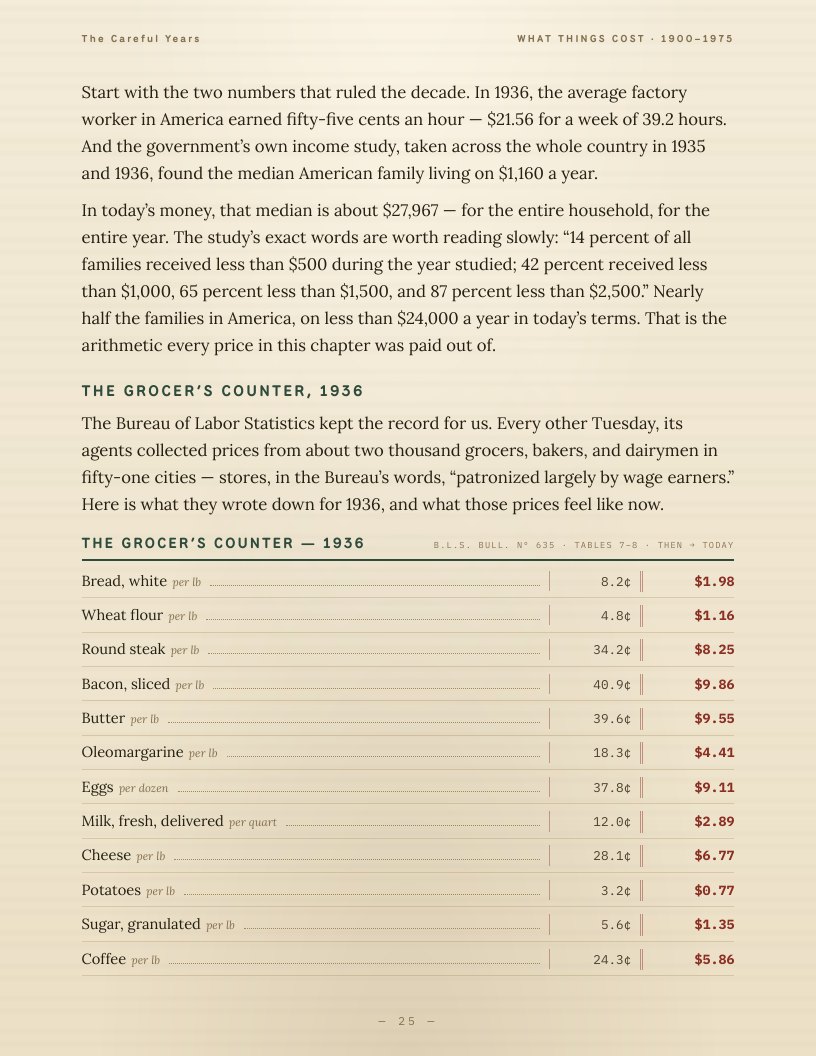
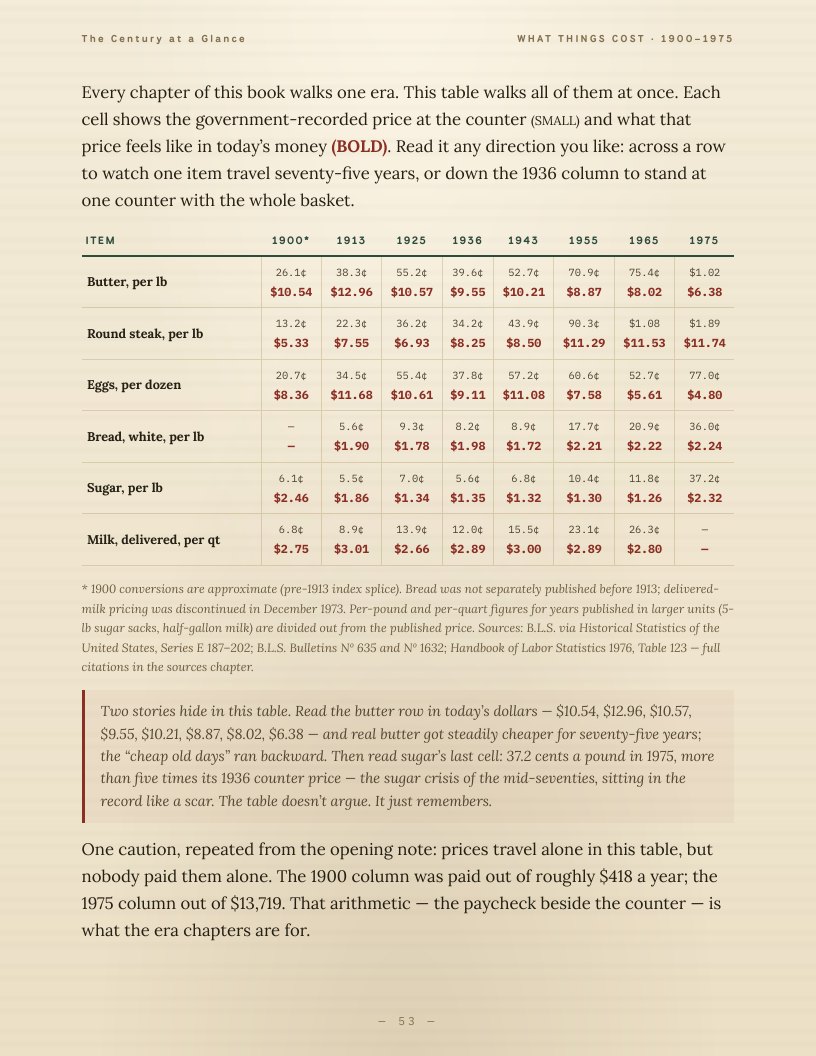
See exactly what you’re getting — eight real pages from Volume I, free.
Eight real pages, no purchase, nothing to install — the same PDF the book comes as.
Or download it directly — no email needed.
Checked Against the Record
Not memory. Not folklore. Not internet lists.
“These agencies distribute the schedules to approximately 2,000 food dealers on the date set for price collection… selected from those patronized largely by wage earners.” — BUREAU OF LABOR STATISTICS, BULLETIN Nº 635, PAGE 10
- Prices transcribed from the original government bulletins — Bureau of Labor Statistics, Census, USDA — page by page.
- Conversions use the Bureau’s own Consumer Price Index. The method is printed in the book so you can check any figure.
- The complete bibliography is part of the book — every table traces to its source.
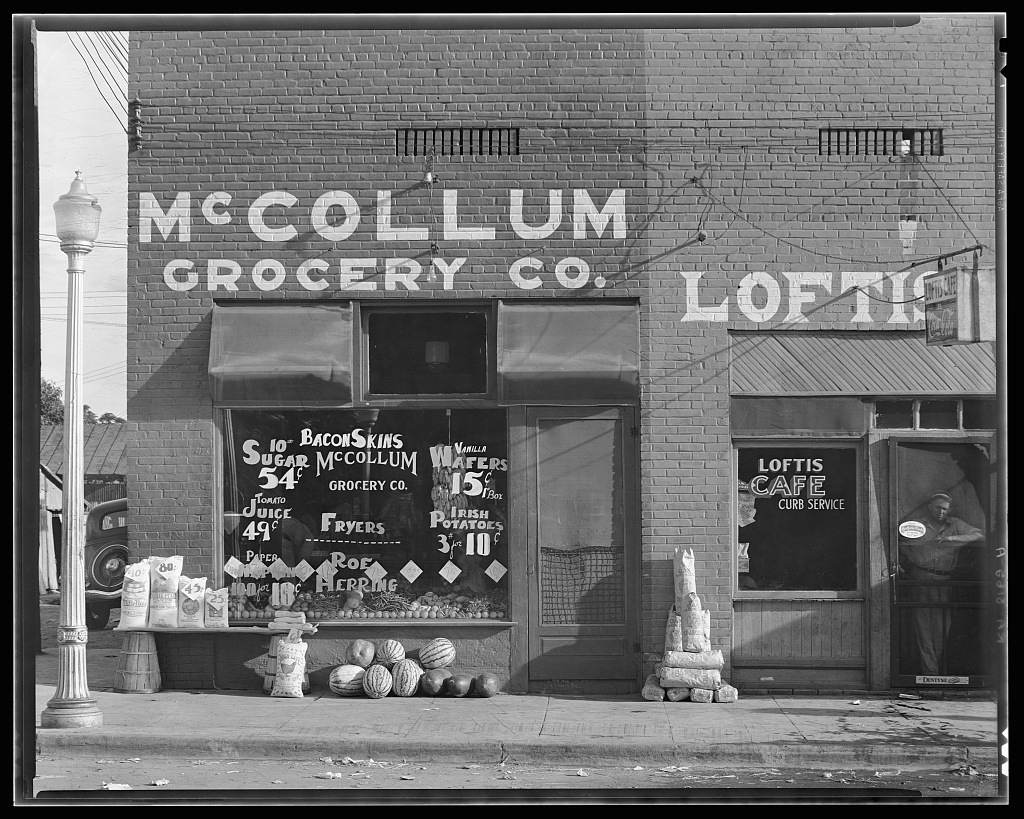
Set in large type on letter paper — print it and it lives by the kitchen door, not in an app.
Fair Questions
Asked by careful people. We’d ask them too.
What exactly do I get?
Did a person actually research this, or is it AI-written filler?
I lived through some of this. Is there anything in it for me?
Is this financial advice?
I’m not great with computers. Will I be able to open it?
What if it’s not for me?
Why $28 — and will the price change?
Why is it called the 2027 Edition?
Own the Record.
- What Things Cost, 1900–1975 — Volume I, 90 pages, instant PDF
- Two hundred verified prices, every one converted to today’s dollars
- The full bibliography — check us against the record
- Large-print-friendly design, made for reading and printing
The Cited-Source Guarantee. Read it, check any figure against the source we printed for it, and if it doesn’t hold up — or simply doesn’t earn its place on your shelf — write us within 7 days and you get every cent back, no questions asked. The risk is ours; that’s how sure we are of the record.
Ask them what bread cost the year you were born. When the answer comes back to the penny — and it will — this is the book that proves them right.
Questions first? Write us: contact@oldwisdombook.com — a person answers.
There are three volumes in the Archive.
SEE ALL THREE & THE COMPLETE ARCHIVE